
Hayli Gubbi Awakens After 12,000 Years: How an Ethiopian Volcano Sent Ash All the Way to Pakistan
For more than twelve millennia, the Hayli Gubbi volcano in Ethiopia was considered a silent relic of the ancient Earth — a geological giant that had long since fallen asleep. That changed in late November 2025, when the volcano suddenly roared back to life, sending shockwaves through the scientific community and casting volcanic ash across multiple countries, even reaching the skies of Pakistan. This is the story of a volcano reborn, an ash cloud that crossed continents, and what this extraordinary event means for the future.
11/25/20253 min read
A Surprise From the Afar Region
Hayli Gubbi is located in Ethiopia’s Afar region, one of the most geologically active places on the planet. Sitting along the East African Rift — where tectonic plates slowly pull apart — the area is dotted with volcanoes, lava fields, and geothermal vents.
Yet even in this restless environment, Hayli Gubbi was considered stable. Geological records suggested no known eruptions during the entire Holocene period (approximately the last 12,000 years). That long dormancy made its sudden awakening all the more dramatic.
When the volcano erupted, it released a towering plume of ash that climbed roughly 14 kilometers into the sky — high enough to enter major aviation corridors.
A Massive Ash Plume Travels Across Continents
Volcanic ash is incredibly light and fine, capable of traveling thousands of kilometers when carried by upper-level winds. After Hayli Gubbi erupted, those winds pushed the ash plume eastward, spreading it over the Red Sea and the Arabian Peninsula.
From there, the ash continued its journey:
drifting over parts of Yemen and Oman,
spreading further into the Indian Ocean region,
and eventually entering the airspace above southern Pakistan.
For Pakistan, this event was remarkable: meteorologists issued the country’s first-ever volcanic ash advisory related to a foreign eruption, as the plume approached the skies over Karachi and coastal regions. Thankfully, most of the ash remained at high altitude, posing minimal risk to people on the ground — but it did prompt heightened caution for aircraft.
Local Impacts in Ethiopia
Closer to the eruption site, the effects were far more tangible:
Ash coated homes, fields, and livestock in nearby communities.
Visibility dropped sharply during the initial eruption.
Local authorities monitored potential contamination of water sources and grazing lands.
The Afar region is home to pastoralist communities whose livelihoods depend heavily on livestock and natural resources. Even a thin layer of volcanic ash can disrupt grazing, contaminate water, and harm animals, making support and cleanup efforts essential.
Aviation Disruptions Across Several Countries
High-altitude volcanic ash is one of the most hazardous conditions for aviation. When sucked into jet engines, ash can melt and solidify, leading to engine failure. For this reason, even distant volcanic activity can cause major flight disruptions.
Following the Hayli Gubbi eruption:
airlines rerouted flights to avoid the ash cloud,
some carriers temporarily suspended flights along affected routes,
aviation authorities across South Asia and the Middle East issued safety advisories.
The event demonstrated just how interconnected global air travel is — and how a single eruption can cascade into disruptions thousands of kilometers away.
Why This Eruption Matters
1. Volcanoes Can Wake Up After Millennia
Hayli Gubbi proves that a long dormancy period doesn’t guarantee permanent inactivity. Volcanoes with no recent history can still erupt with significant force, especially in tectonically active regions.
2. Monitoring Remote Volcanoes Is Critical
Many volcanoes in the Afar region are difficult to monitor from the ground due to extreme heat, rugged terrain, and limited infrastructure. Satellite-based monitoring played a crucial role in detecting and tracking this eruption.
3. Volcanic Events Are Global, Not Local
The ash cloud’s journey from Ethiopia to Pakistan shows how atmospheric systems can carry volcanic materials across continents. Countries far from active volcanic zones must still prepare for potential aviation and air-quality impacts.
4. Climate and Environment Studies Gain Valuable Data
Large eruptions release dust, ash, and gases such as sulfur dioxide into the atmosphere. Scientists will study the Hayli Gubbi plume to understand how it may temporarily influence regional weather patterns or sunlight scattering.
What Comes Next?
Scientists will continue to monitor Hayli Gubbi closely in the coming months. It’s not yet known whether the eruption was a singular event or the beginning of a longer active phase.
Key areas of focus include:
tracking any new seismic or volcanic activity,
assessing long-term community and environmental impacts,
studying ash dispersion patterns,
evaluating aviation risks as residual ash spreads and dissipates.
Researchers also hope to learn more about the volcano’s magma system — knowledge that could help forecast future behavior.
Conclusion
The awakening of Hayli Gubbi after 12,000 years is more than a geological milestone — it’s a reminder of our planet’s immense power and unpredictability. From the remote deserts of Ethiopia to the busy air corridors of Pakistan, the eruption’s effects rippled far beyond its origins.
In a world where natural events can quickly become global events, the Hayli Gubbi eruption underscores the importance of preparedness, monitoring, and international cooperation.
Disclaimer
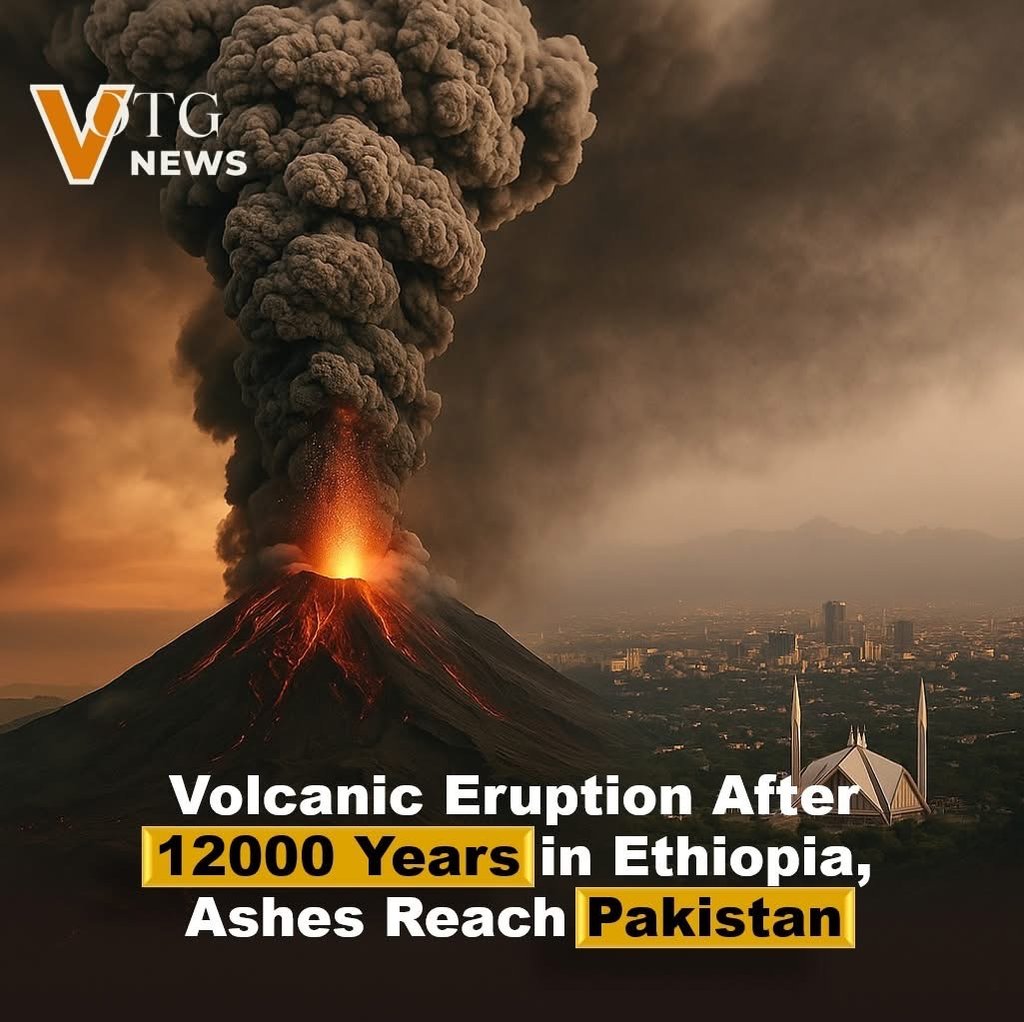
The image is AI-generated only for illustration