
How Pakistani and Chinese Researchers Are Using Smart Technology to Protect Crops from Extreme Heat
Climate change is no longer a distant threat for farmers—it is a daily reality. Rising temperatures, prolonged heatwaves, and increasing water scarcity are placing enormous pressure on agricultural systems, particularly in countries like Pakistan. In response to these challenges, a team of Pakistani and Chinese researchers has developed an innovative smart irrigation solution designed to protect crops from heat stress while using water more efficiently.
1/15/20262 min read
The Challenge: Heat Stress and Water Scarcity
Extreme heat can severely damage crops by raising leaf and soil temperatures, reducing photosynthesis, and accelerating water loss. Traditional irrigation methods often fail to address these issues effectively. They either apply water too late, waste precious resources, or cannot adapt quickly to changing weather conditions.
For countries with arid and semi-arid climates, this combination of heat stress and limited water availability threatens food security and farmer livelihoods. Recognizing this urgent problem, researchers from Pakistan and China joined forces to create a technology-driven solution.
The Smart Irrigation Solution
The newly developed system uses precision irrigation combined with real-time environmental monitoring. Instead of relying on fixed schedules, the system responds dynamically to actual field conditions.
Key features include:
Temperature and soil-moisture sensors installed in crop fields
Automated irrigation controls that activate when heat stress reaches critical levels
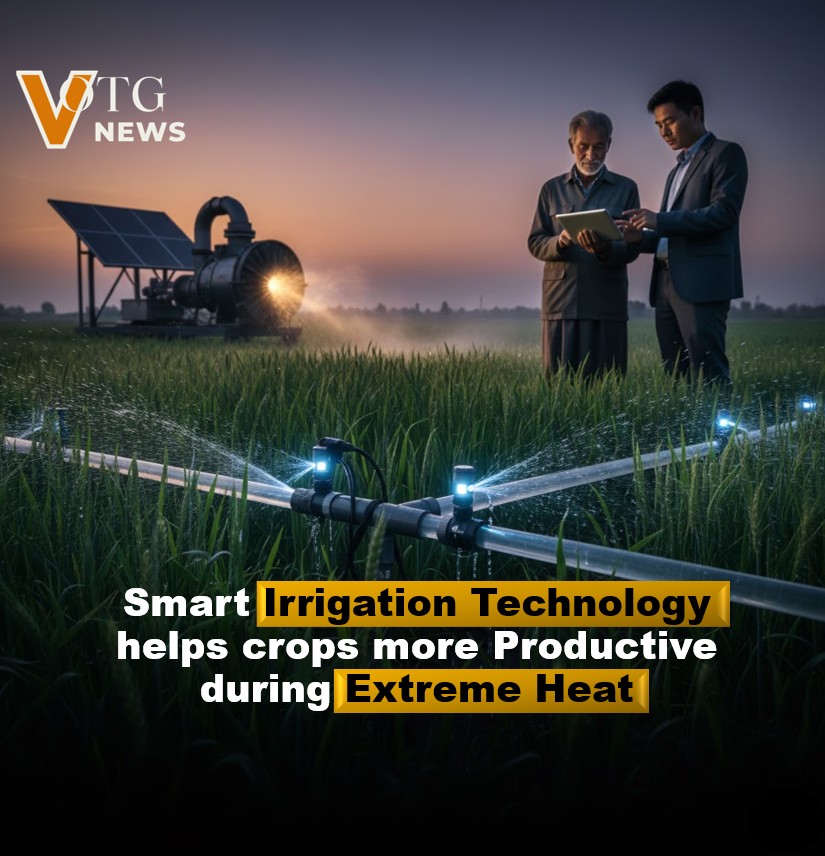
A combination of drip irrigation and micro-sprinklers to cool crops efficiently
Remote monitoring through cloud-based platforms, allowing farmers or technicians to manage irrigation from anywhere
When temperatures rise beyond safe thresholds, the system automatically releases fine water sprays. This not only hydrates the plants but also lowers the surrounding air and leaf temperature, helping crops maintain healthy growth during extreme heat.
Why This Innovation Matters
This smart approach delivers multiple benefits at once:
Reduced heat damage: By cooling crops at the right moment, plants experience less stress and maintain better productivity.
Improved water efficiency: Water is applied only when and where it is needed, reducing waste.
Higher crop resilience: Plants can withstand longer and more intense heatwaves.
Adaptability: The system can be scaled for small farms, greenhouses, or large commercial operations.
In regions where every drop of water counts, such efficiency can make the difference between crop failure and a successful harvest.
A Strong Example of International Collaboration
The project highlights the growing strength of Pak-China cooperation in agricultural research. By combining local knowledge of Pakistan’s climate challenges with advanced technological expertise from China, the researchers created a practical solution tailored to real-world conditions.
Their findings have been published in an international scientific journal, and the next phase focuses on large-scale field trials. These trials will help adapt the technology for different crops, soil types, and regional climates.
Looking Ahead
As global temperatures continue to rise, smart farming solutions like this will become increasingly important. Technology alone cannot solve climate change, but it can help farmers adapt and protect their livelihoods.
This smart irrigation system offers a promising path forward—one that balances innovation, sustainability, and food security. With further testing and adoption, it could play a key role in shaping the future of climate-resilient agriculture in Pakistan and beyond.
Disclaimer: This update is shared based on publicly available information. VOTG News is not responsible for any decisions made based on this news. The image is AI-generated only for illustration