
Pakistan’s ‘Crypto Minister’ Resigns: What His Exit Means for the Country’s Digital Future
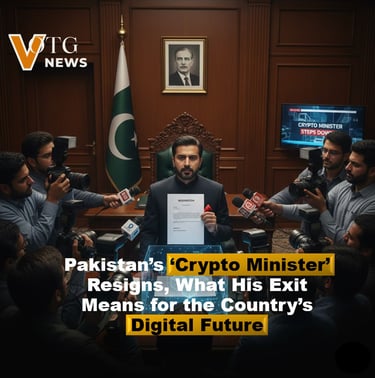
Pakistan’s fast-evolving crypto and blockchain landscape took a surprising turn this week as Bilal Bin Saqib, widely known as the country’s “Crypto Minister,” officially stepped down from his position as Special Assistant to the Prime Minister (SAPM) on Blockchain & Crypto. His role carried the status of a Minister of State, making his resignation a notable development in Pakistan’s tech-policy world.
12/2/20251 min read

Why Did He Resign?
According to official reports, the resignation stemmed from a technical regulatory conflict rather than political pressure or policy disagreement. Under the Rules of Business, 1973, an individual cannot simultaneously hold a ministerial/SAPM position and head a statutory regulatory authority.
Bilal Bin Saqib was also serving as Chairman of the Pakistan Virtual Assets Regulatory Authority (PVARA). This dual role clashed with the regulations, making a resignation unavoidable.
Instead of stepping down from PVARA, he chose to leave the SAPM post — a move that aligns with compliance requirements but doesn’t halt the progress of crypto regulation in Pakistan.
What This Means for Pakistan’s Crypto Policy
Despite the sudden announcement, the government has clarified that Pakistan’s crypto and blockchain initiatives remain active. Efforts under PVARA, including national-level frameworks and regulatory roadmaps, continue without interruption.
Interestingly, Bilal Bin Saqib is still expected to represent Pakistan at Binance Blockchain Week in Dubai, signaling that the country’s engagement with global blockchain platforms remains intact.
This shows that:
The resignation is procedural, not ideological.
Pakistan is moving toward a clearer and more professional regulatory structure.
Crypto and blockchain policy development is still a running priority.
A Step Toward Stronger Regulation
The separation of political office from regulatory leadership may strengthen public trust in Pakistan’s virtual asset ecosystem. It helps avoid conflicts of interest and makes room for a more transparent, credible framework—something the crypto community has long called for.
For entrepreneurs, exchanges, and investors, this shift may ultimately lead to more stable, predictable guidelines and smoother compliance procedures.
What Comes Next?
All eyes are now on two big questions:
Who will replace the outgoing SAPM?
How will PVARA continue shaping Pakistan’s crypto infrastructure into 2026?
One thing is clear: Pakistan’s digital finance journey is far from over. With regulatory reform gaining momentum and global engagement underway, the country appears committed to building a structured, modern, and internationally aligned crypto ecosystem
Disclaimer
This update is shared based on publicly available information. VOTG News is not responsible for any decisions made based on this news. The image is AI-generated only for illustration.