
US National Hunts Rare Markhor in Pakistan for Rs 6.8 Crore — What Really Happened?
A recent trophy hunt in Pakistan’s northern mountains has captured global attention after a 75-year-old American hunter legally harvested a rare Kashmir Markhor, the national animal of Pakistan. The hunt took place in the Tushi-Shasha Conservancy of Lower Chitral and came with an eye-watering price tag: 💵 US $243,000—roughly Rs 6.83 crore. This event has reignited debate around Pakistan’s controversial yet internationally recognized trophy hunting program, which allows a limited number of hunts each year under strict regulations.
12/12/20252 min read

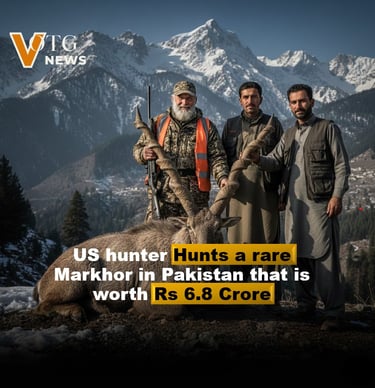
The Hunt: What Happened?
The hunter, identified as Thomas Garrick Steele, secured the trophy under an official government permit. The Markhor he harvested boasted impressive 55-inch horns, a key factor that often drives the bidding price of hunting permits to extraordinary levels.
The hunt was carried out under supervision from wildlife officials and local community representatives, ensuring compliance with conservation laws. Because Steele obtained an exportable trophy permit, he is legally allowed to take the horns outside Pakistan.
Pakistan’s Trophy Hunting Program: How It Works
Pakistan issues a limited number of permits each year for species like the Kashmir Markhor, Astore Markhor, blue sheep, and ibex. These permits are auctioned internationally—primarily to wealthy hunters from the US and Europe.
Here’s what many people don’t know:
80% of the permit fee goes directly to local communities.
This revenue funds welfare programs, infrastructure, and wildlife protection.
Only elderly, non-breeding animals are selected
A panel identifies older males that have already contributed genetically and may not survive harsh winters.
The program is credited with boosting Markhor populations
Once endangered due to poaching, Markhor numbers have grown significantly where community-led conservation is practiced.
A Trend of Record-Breaking Bids
In recent years, Pakistan’s trophy hunting permits have set multiple global records:
In 2024, an American hunter paid US $271,000 for a Markhor permit in Chitral.
The 2025–26 season saw a permit in Gilgit-Baltistan climb to US $370,000, one of the highest ever recorded for any wild goat species.
These high bids draw both praise and criticism, sparking intense discussions around ethics and conservation.
The Debate: Conservation Tool or Ethical Dilemma?
Trophy hunting in Pakistan remains deeply divisive.
Supporters argue:
It protects wildlife by funding anti-poaching patrols.
It gives mountain communities a profitable reason to protect endangered species.
It replaces illegal hunting with a regulated, sustainable system.
Critics counter:
Killing rare wildlife—even legally—feels morally wrong.
Conservation shouldn’t depend on wealthy foreigners shooting iconic species.
The system requires greater transparency and monitoring.
Both sides raise valid points, and the debate has only intensified with each high-value hunt.
Final Thoughts
The latest Markhor hunt in Chitral is more than a headline about an expensive trophy. It highlights the complex intersection of conservation, community livelihoods, international hunting culture, and wildlife ethics.
Whether one views it as a necessary conservation tool or an uncomfortable luxury sport, there’s no denying the impact of Pakistan’s trophy hunting program on global wildlife conversations—and on the remote mountain communities that depend on its revenue.
Disclaimer: This update is shared based on publicly available information. VOTG News is not responsible for any decisions made based on this news. The image is AI-generated only for illustration